
Guttering.org: The Technical Repository of the Network
This is not a general home improvement site. Guttering.org is the calculation and reference layer of the guttering.com network — a strictly educational, non-commercial repository of mathematical layout data, drainage engineering principles, safety compliance references, and code-standard documentation built for the professionals who design, specify, and approve residential and commercial guttering systems before a single hanger goes into a fascia board. If you arrived here looking for contractor-grade technical depth on guttering — not simplified tutorials, not rounded approximations, not content written by someone who has never held a pair of aviation snips — you are in the right place.
The field techniques, calculation frameworks, and engineering principles published on this domain are grounded in 31 years in the trades — accumulated across seamless aluminum production installs, hand-fabricated copper half-round restoration work, and chronic drainage failure diagnostics traced back to single-point specification errors made long before the first crew arrived on site. That baseline of hands-on experience is what separates the reference data here from anything derived from manufacturer documentation or academic theory disconnected from real installation conditions.
What Guttering.org Contains
The content architecture of this domain is organized around four primary technical pillars: layout math and drainage calculations, safety standards and code compliance references, drainage engineering principles, and regional climate-specific installation guidance. Each pillar is built to the standard of a working field reference — accurate, precise, and written to a professional baseline that does not require simplification to be useful.
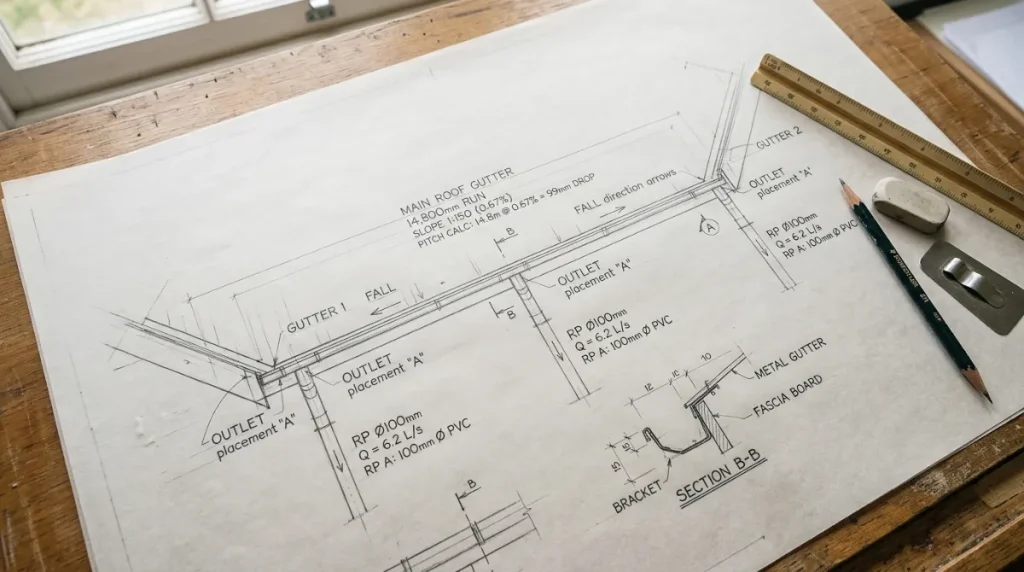
Layout Math and Drainage Calculations
Proper layout math is the foundation of every guttering system that performs correctly over the long term. Cumulative errors introduced by rounded approximations, miscalculated pitch, or undersized outlet configurations do not show up on inspection day — they show up three years later as foundation saturation, fascia rot, and overflow events during the first heavy regional rain. The calculation content on this domain is built to eliminate that category of failure at the design stage.
- Pitch and slope formulas — precise drop-per-linear-foot calculations for single-outlet, dual-outlet, and center-outlet guttering configurations across standard and non-standard run lengths, with documented correction factors for long runs exceeding 40 linear feet
- Drainage load calculations — roof square footage to downspout diameter ratios by regional rainfall intensity classification, including correction factors for valley-concentrated discharge points where standard sizing consistently underperforms
- Thermal expansion tables — linear expansion coefficients for aluminum, copper, galvanized steel, and vinyl across documented regional temperature swing ranges, with practical application notes for joint placement and slip-joint spacing on long runs
- Hanger load and spacing calculations — pull-out force ratings by fastener type, substrate material, and hanger interval for both static load and ice-load conditions, including the minimum embedment depths required for reliable structural integrity in freeze-thaw climate zones
- Outlet sizing and placement logic — the interaction between cross-sectional gutter area, outlet diameter, and pitch that determines actual hydraulic flow capacity versus nominal capacity on the product specification sheet
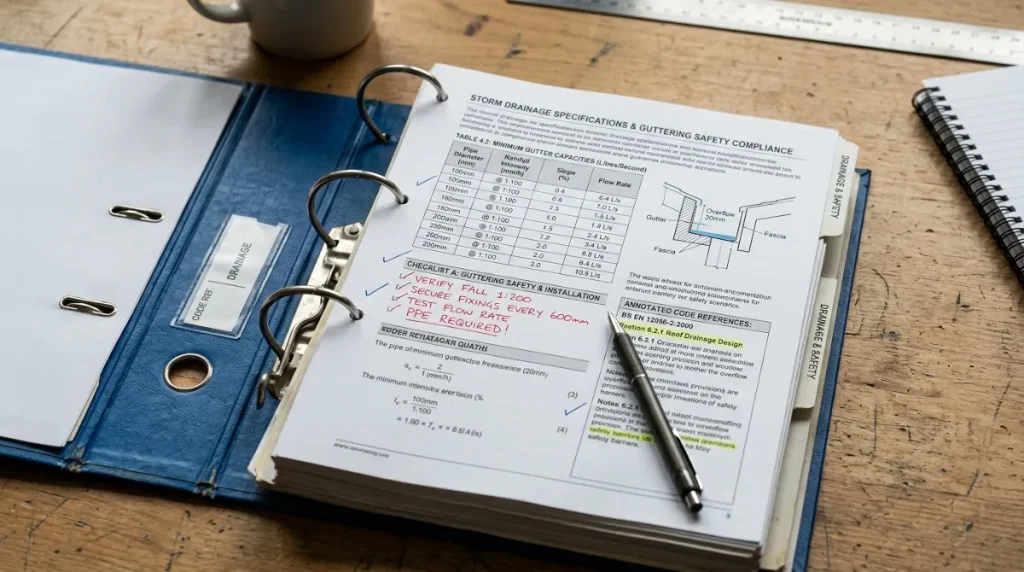
Safety Standards and Code Compliance Reference
Drainage system failures that result in structural damage, foundation compromise, or safety incidents frequently trace back to specification errors made at the design stage — not installation errors made in the field. The specification professional who selects the wrong outlet diameter, places a discharge point against a foundation wall, or approves a hanger spacing interval that cannot carry ice load has introduced a failure that no amount of field-quality installation can correct. This domain publishes reference documentation targeted specifically at that specification and approval stage.
- IRC and IBC drainage references — relevant code sections governing roof drainage system design, minimum slope requirements, and downspout discharge placement for residential and light commercial construction, with plain-language interpretation notes for common specification scenarios
- OSHA at-height compliance summaries — applicable fall protection standards for guttering installation and maintenance work at residential and commercial roofline heights, including the trigger heights, anchor point requirements, and equipment standards that apply to production gutter crews
- Material specification standards — ASTM material designations for aluminum, copper, and galvanized steel gutter products including gauge tolerances, alloy specifications, and minimum thickness requirements by application type and exposure category
- Warranty and compliance interaction documentation — how guttering guard installation, hanger type selection, and drainage system modifications interact with roofing manufacturer warranty terms, and the specific installation conditions that void coverage without triggering any visible installation defect
Drainage Engineering Principles
Calculation tables produce correct numbers. Engineering principles explain why those numbers matter — and what happens structurally when they are ignored. Understanding how water moves across a roof surface, through a collection trough, and away from a structure at a mechanical level is what separates a drainage system designed to perform from one designed to pass inspection. This content layer addresses that distinction directly.
- Hydraulic flow principles applied to residential guttering sizing — why cross-sectional area, outlet placement, and pitch interact to determine actual flow capacity rather than nominal capacity, and how to calculate the real-world performance gap between the two on complex rooflines
- Hydrostatic pressure and foundation interaction — how discharge volume, soil permeability, and discharge point placement determine whether a drainage system protects or actively compromises a foundation over a multi-year service period
- Ice dam formation mechanics — the thermal conditions, insulation failures, and drainage design factors that create ice dam risk, and the specification decisions at the guttering system level that mitigate or accelerate that risk depending on how they are executed
- Valley discharge concentration — the hydraulic amplification effect at roof valley termination points and the outlet sizing, placement, and trough profile adjustments required to manage concentrated discharge without overflow events
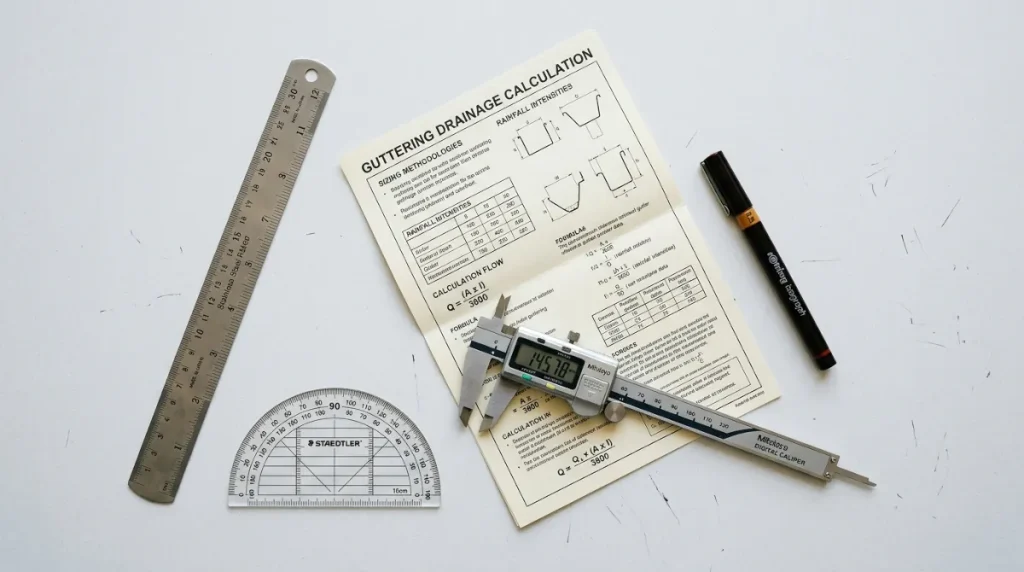
Regional Climate-Specific Installation Guidance
Standard guttering installation references are written for average conditions. Real-world drainage solutions are installed in specific regional climates — and the performance gap between a system correctly specified for its regional environment and one installed to a generic national standard is measurable, predictable, and entirely preventable at the design stage. This domain addresses regional variation as a primary technical variable, not a footnote.
- High-rainfall coastal and southeastern regions — outlet sizing corrections for rainfall intensity events that exceed the design parameters of standard residential guttering specifications, including the specific trough profile and downspout diameter upgrades that maintain proper water diversion under peak load conditions
- Freeze-thaw climate zones — hanger spacing intervals, fastener embedment depths, and expansion joint placement requirements for regions with documented multi-cycle freeze-thaw seasons where ice load is a primary structural variable, not a secondary consideration
- High-wind exposure zones — fascia attachment standards, hanger pull-out resistance requirements, and end cap sealing specifications for coastal and open-terrain installations where wind-driven rain and uplift forces exceed standard residential exposure assumptions
- Arid and low-rainfall regions — the specific debris accumulation, UV degradation, and thermal expansion conditions that dominate guttering system performance in low-precipitation climates where water flow is infrequent but thermal cycling is extreme
Who Guttering.org Is Built For
The editorial baseline on this domain is set at the professional specification level. The content is not simplified for a general homeowner audience, and it does not assume the reader needs basic trade concepts explained from the ground up. The target reader for every reference document, calculation table, and engineering principle published here is a professional who already understands the field and needs accurate, field-verified data to do their work correctly.
- Licensed residential and commercial contractors who need technical reference material written to a professional standard — specifically crew leads, estimators, and project managers making specification decisions on complex multi-story, multi-valley, or historically significant roofline configurations
- Property managers and facilities directors overseeing multi-unit or commercial properties where guttering system failures carry significant structural and financial consequences and where preventative maintenance decisions require documented technical justification
- Advanced DIY homeowners tackling complex roofline configurations, historical restoration work, or high-end copper and steel material installations that require a higher level of precision than standard installation guides provide
- Architects, structural engineers, and construction professionals who need accurate, field-verified drainage and water diversion reference material that reflects real-world installation conditions rather than manufacturer specification sheets written to minimize liability
- Municipal building and inspection professionals who reference drainage system design standards in the context of permit review, code compliance verification, and post-installation inspection

The Network This Site Belongs To
Guttering.org is the technical reference domain in a three-site network founded and operated by C. David Chase — a retired residential contractor with 31 years of active field experience across the full exterior envelope of residential construction. That experience covers seamless aluminum installation on production residential builds, hand-fabricated copper half-round work on historical restoration projects, chronic drainage failure diagnostics traced to single-point installation errors, and the kind of accumulated material knowledge that only comes from decades of field work — not from reading manufacturer documentation or aggregating content from other websites.
The editorial standard across every domain in this network is unchanged and non-negotiable: every guide is accurate, every technique is field-tested, every product assessment is honest, and no content is published that the author would not stand behind on an actual job site. That standard was established at guttering.com and it travels with every domain that carries the network’s name.
- Guttering.com — Installation guides, guard reviews, repair diagnostics, and field technique content for homeowners, DIYers, and property managers tackling residential guttering projects
- Guttering.net — Advanced technical content, regional installation guidance, and trade reference material for licensed contractors, crew leads, and construction professionals working at a production scale
- Guttering.org — Drainage calculation data, engineering principles, safety compliance references, and code documentation for architects, engineers, facilities professionals, and specification-level trade practitioners
Get in Touch
Technical inquiries from architects, engineers, facilities directors, and construction professionals are welcome. If you are working on a specification, a compliance review, or a drainage design problem that the existing reference content does not fully address, reach out directly. Detailed questions about specific projects or technical challenges will receive a direct response.
- Phone: 865-226-9721
- Email: david@guttering.com
The full library of contractor-grade installation guides, guttering guard reviews, repair diagnostics, and field technique content is live and available now at guttering.com. If you have a specific guttering question, a repair situation you cannot diagnose, or a project that needs a straight answer from someone who has actually done the work, that is the place to start.
Every calculation table, engineering reference, and drainage specification document published on this domain reflects field-tested methods developed and verified across 31 years of production-scale contracting work — covering residential new construction, historical restoration, and complex multi-story drainage system diagnostics. No formula is published here that has not been validated against real installation outcomes. No specification guidance is offered that has not been stress-tested against the conditions that actually cause guttering systems to fail. That is the standard this network was built on, and it is the standard every page on this domain is held to.
As an Amazon Associate, I earn from qualifying purchases at no extra cost to you.