
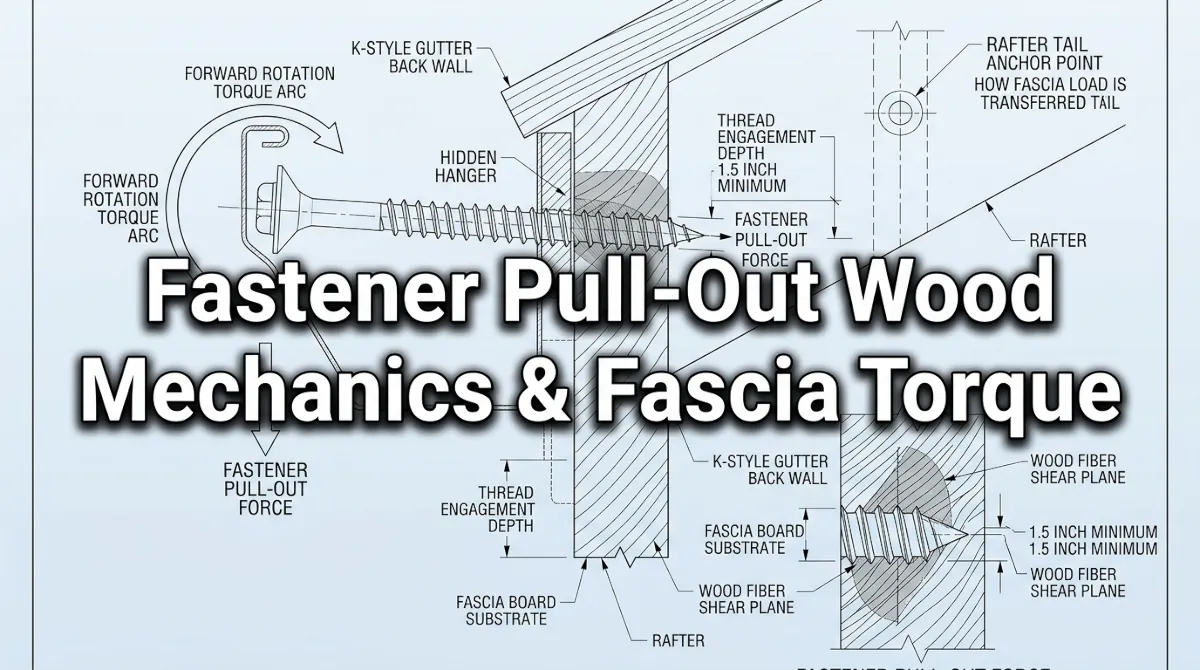
Fastener Pull-Out Wood Mechanics & Fascia Torque: Fastener Field Manual
A guttering system is only as structurally sound as the wood it is anchored into. The hanger, the screw, the trough geometry — none of it matters if the fastener is pulling through degraded wood fiber under load. Fastener pull-out wood mechanics & fascia torque is the structural baseline that determines whether a correctly spaced hanger system holds through a 30-year service life or begins rotating away from the roofline within five seasons of installation.
This reference documents the thread engagement requirements, pull-out resistance values by wood species, substrate degradation mechanics, and the rotational torque failure mode that occurs when fasteners are anchored exclusively through fascia board without bearing against rafter tail backing.
Wood Species Pull-Out Resistance: Baseline Data by Substrate
Screw pull-out resistance in wood is a function of four variables: wood species specific gravity, fastener shank diameter, thread pitch, and embedment depth. The following data reflects lateral withdrawal resistance values for a standard #10 coarse-thread screw (0.190-inch shank diameter) at a 1.5-inch thread engagement depth — the minimum embedment achieved when a standard hidden hanger screw passes through a 0.027-inch aluminum trough back wall and a nominal 0.75-inch fascia board and engages the substrate behind it.
| Substrate Material | Specific Gravity | Pull-Out Resistance at 1.5-inch Engagement | Pull-Out Resistance at 2.5-inch Engagement | Freeze-Thaw Degradation Factor |
|---|---|---|---|---|
| Southern Yellow Pine (SYP) | 0.55 | 148 lbs | 247 lbs | Low — dense grain resists moisture cycling |
| Douglas Fir | 0.50 | 132 lbs | 220 lbs | Low to moderate |
| Spruce-Pine-Fir (SPF) | 0.42 | 108 lbs | 180 lbs | Moderate — common production framing species |
| Eastern White Pine | 0.35 | 88 lbs | 147 lbs | High — low-density grain degrades rapidly under moisture cycling |
| Cellular PVC (foam board) | N/A | 35 to 55 lbs | 55 to 80 lbs | No moisture degradation — but base pull-out resistance is critically low |
Critical read on cellular PVC: Cellular PVC fascia board is widely used in modern residential construction for its moisture resistance and paint retention. Its pull-out resistance is 60% to 75% lower than SPF at equivalent embedment depth. A standard hidden hanger screw terminating in cellular PVC fascia without rafter tail engagement delivers 35 to 55 pounds of pull-out resistance — below the per-hanger load generated at 24-inch spacing under frozen load conditions documented in the companion bracket spacing reference.
Thread Engagement Depth: The Minimum Embedment Standard
Thread engagement depth is the length of the fastener shank that is actively in contact with wood fiber — not the total screw length. The distinction matters because a 3-inch screw driven through a 0.75-inch fascia board and a 0.027-inch trough back wall achieves only 2.22 inches of thread engagement in the substrate behind the fascia face. The remaining screw length is passing through air, trough metal, and fascia board face material that contributes nothing to pull-out resistance.
The minimum functional thread engagement depth for a hidden hanger screw in residential guttering applications is 1.5 inches into structural substrate — meaning 1.5 inches of threaded engagement beyond the fascia board face, not including the fascia board thickness itself.
- Fascia-only installation (nominal 0.75-inch fascia board): A 2.5-inch screw achieves 1.5-inch engagement into the fascia substrate — meets the minimum standard only if the fascia board is sound, dense-grain lumber. Provides no rafter tail engagement.
- Fascia-plus-sheathing installation (0.75-inch fascia + 0.5-inch sheathing behind): A 2.5-inch screw passes through both layers and achieves approximately 1.0 inch of engagement into the sheathing — below the minimum standard. A 3.0-inch screw is required to meet the 1.5-inch minimum in this configuration.
- Rafter tail engagement installation (0.75-inch fascia + rafter tail bearing): A 3.0-inch or longer screw driven into the rafter tail achieves 1.5 to 2.0 inches of engagement in structural framing lumber — the highest pull-out resistance configuration available without supplemental backing.
Wood Fiber Degradation: How Substrates Fail Over Time
Pull-out resistance figures represent the performance of sound, dry lumber at initial installation. Fascia board in an exterior roofline application is not consistently sound and dry across a multi-decade service life. Two degradation mechanisms progressively reduce pull-out resistance at every fastener location in the run.
Moisture Cycling Degradation
Wood expands when it absorbs moisture and contracts when it dries. Fascia board on an exterior roofline undergoes this cycle repeatedly — sometimes multiple times within a single week during wet seasons. Each expansion-contraction cycle works the wood fiber around the screw thread microscopically.
Over 50 to 100 moisture cycles — a conservative estimate for a single year of exterior exposure in a humid climate — the wood fiber immediately adjacent to the screw thread compresses and partially crushes. The thread engagement zone becomes slightly oversized relative to the fastener shank. Pull-out resistance drops. In low-density species like Eastern White Pine, this degradation is measurable within three to five years of installation. In high-density SYP, the process takes longer but is not eliminated.
Micro-Vibration Fatigue
Wind loading on a guttering system generates continuous low-amplitude vibration at every hanger location. The trough acts as a sail — particularly on long exposed runs — and transfers wind energy into the hanger-fascia connection as cyclical micro-movement. Each micro-vibration cycle applies a small shear and withdrawal force to the fastener simultaneously.
Over thousands of cycles per season, micro-vibration fatigue elongates the fastener hole in the wood fiber. The elongation is not visible externally — the screw head sits flush and the trough appears correctly positioned. But the effective thread engagement depth has decreased, and the pull-out resistance has dropped proportionally. The failure becomes visible only when a load event — ice accumulation, wind gust, or impact — exceeds the degraded resistance threshold and the fastener pulls through.
Forward Rotation Torque: Why Fascia-Only Anchoring Fails Under Load
Pull-out resistance addresses the vertical withdrawal force on the fastener. It does not address the rotational torque force that a loaded gutter trough generates at the hanger connection point. These are two distinct structural demands, and fascia-only anchoring fails the second one even when it passes the first.
The Rotational Moment Arm
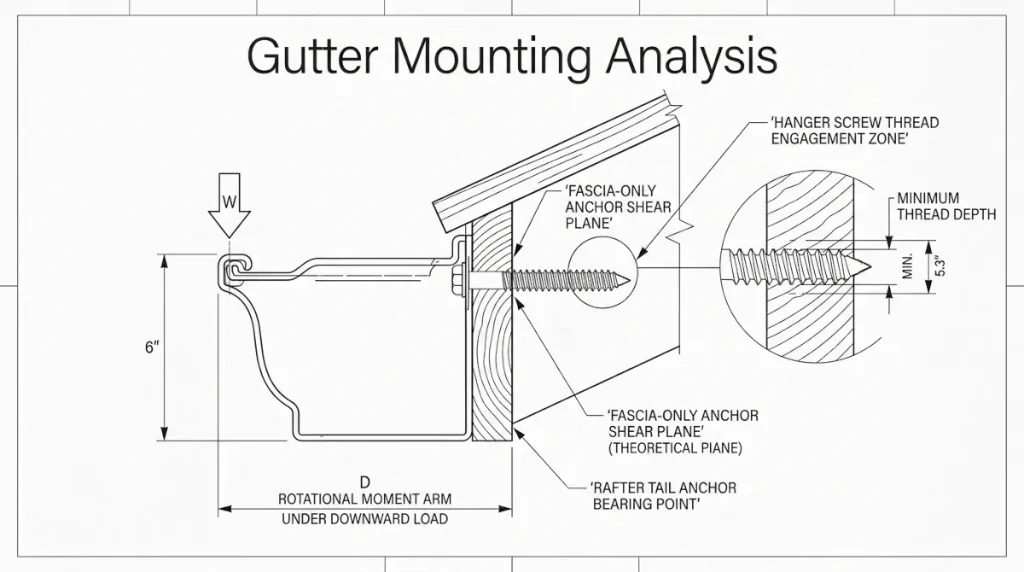
A K-style gutter trough projects 5 to 6 inches outward from the fascia face. When the trough carries load — water, ice, or debris — that load acts at the centroid of the trough cross-section, approximately 2.5 to 3.0 inches forward of the fascia face. The hanger screw is anchored at the fascia face. The distance between the load application point and the anchor point is the moment arm of the rotational force.
A 10-pound load at 2.75 inches forward of the fascia face generates a rotational moment of 27.5 inch-pounds at the fastener location. That moment attempts to rotate the top of the hanger forward — pulling the screw head away from the fascia surface and driving the screw tip deeper into the substrate in a lever action. Under sustained load, this lever action progressively crushes the wood fiber at the screw tip bearing zone and works the screw head free at the trough back wall.
Rafter Tail Anchoring as Rotational Resistance
Driving the hanger screw into the rafter tail — rather than terminating in the fascia board alone — changes the structural geometry of the anchor fundamentally. The rafter tail is a structural framing member with its own bearing resistance against the top plate and roof sheathing. A screw engaged in the rafter tail transfers the rotational moment into the framing assembly rather than resolving it entirely through wood fiber compression at the fascia board.
- Fascia-only anchor under rotational load: The full moment is resolved through wood fiber compression at the screw tip — the weakest point in the connection, subject to progressive crushing under sustained load
- Rafter tail anchor under rotational load: The moment is transferred to the rafter tail bearing assembly — a structural connection that does not degrade under the same mechanisms as fascia board fiber compression
- Minimum rafter tail engagement for rotational resistance: 1.5 inches of screw thread engagement beyond the fascia board face and into the rafter tail body — achieved with a minimum 3.0-inch screw in standard construction where rafter tails are accessible at the fascia line
Where rafter tails are not accessible — as in some truss roof configurations where the fascia is attached to a fly rafter or continuous blocking rather than individual rafter tails — supplemental backing must be installed behind the fascia board to provide equivalent rotational resistance. A continuous 2×4 pressure-treated nailer installed flat against the wall sheathing behind the fascia board, fastened to the wall framing, provides an adequate structural bearing surface for hanger screws in these configurations.
For current ASTM standards governing wood screw withdrawal resistance calculations, specific gravity values by wood species, and fastener diameter specifications applicable to structural wood connections in exterior applications, consult the official standards documentation maintained at ASTM International at astm.org.
Substrate Inspection Protocol Before Installation
Pull-out resistance figures are only valid for sound substrate material. Before setting any hanger on a re-installation or repair project, the fascia board condition must be assessed at every proposed hanger location — not just at visibly damaged sections.
- Probe test: Drive a sharp awl or ice pick into the fascia face at the proposed hanger location with hand pressure only — if the tool penetrates more than 1/4 inch without resistance, the wood fiber at that location is too degraded to provide rated pull-out resistance and the hanger must be relocated to sound material or supplemental backing must be installed
- Moisture content check: Fascia board moisture content above 19% indicates active moisture absorption — fasteners driven into wet wood will lose pull-out resistance as the board dries and the fiber shrinks away from the thread engagement zone. Allow the substrate to dry below 19% moisture content before installation wherever possible
- Existing hole assessment: Never re-use an existing fastener hole for a new hanger screw — the wood fiber in the existing hole has already been compressed by the previous fastener cycle and will not provide rated pull-out resistance for the new fastener regardless of screw size
The structural mechanics documented in this reference connect directly to the load distribution and spacing interval standards covered in the companion article Bracket Spacing Math & Snow Load Structural Shear where per-hanger load figures under frozen conditions are calculated against the pull-out resistance values documented here.
Executing fastener pull-out and fascia torque specifications correctly in the field depends on having the right screw drivers, torque-controlled drivers, and substrate assessment tools staged and ready before the first hanger goes in — a full reference to the professional tool rig required to execute these structural anchoring standards at a production level is available at guttering.com.