
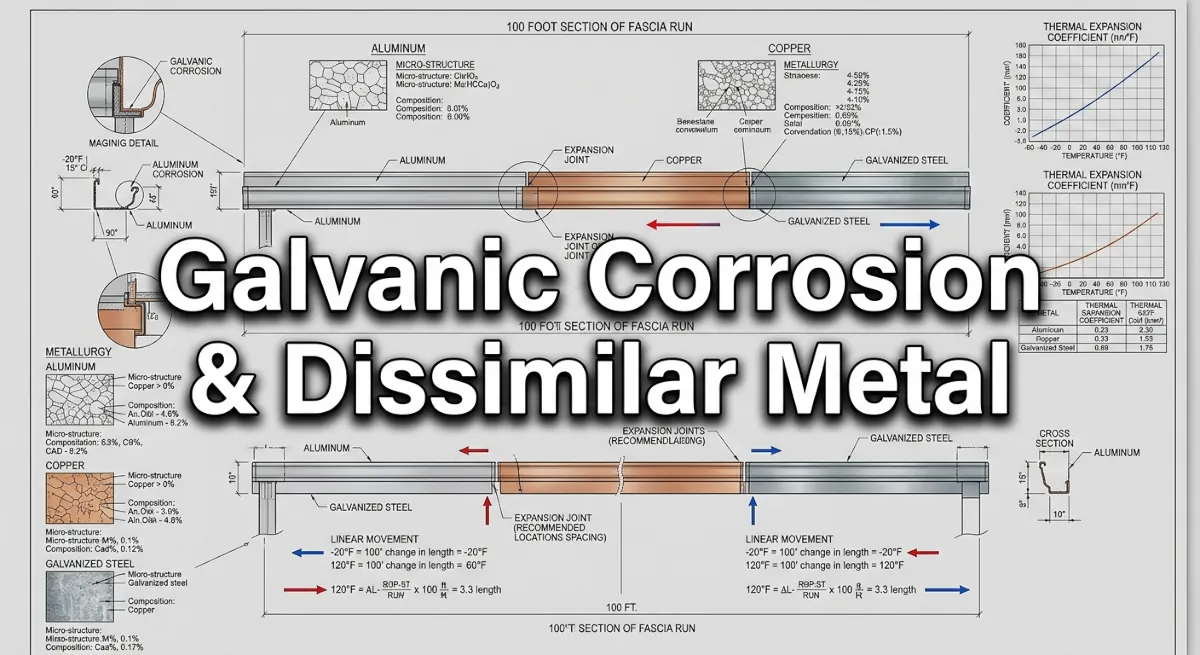
Galvanic Corrosion & Dissimilar Metal Mitigation in Architectural Guttering Systems
Every time an installer drives a steel screw through a copper gutter trough, or routes copper downspout discharge into an aluminum leader, an electrochemical reaction begins. It is invisible on installation day. It is measurable within one season. It is structurally destructive within three to five years.
One crucial aspect to consider is the role of Galvanic Corrosion & Dissimilar Metal interactions in architectural applications.
Understanding Galvanic Corrosion & Dissimilar Metal effects helps in preventing long-term damage.
Galvanic corrosion & dissimilar metal interaction is not a theoretical concern for architectural guttering work — it is the primary long-term failure mechanism on any system where metal selection and fastener specification are made without reference to the galvanic compatibility of the materials in contact. This reference documents the electrochemical mechanics, the galvanic series positions of the metals used in residential and commercial guttering, and the exact field isolation protocols required to permanently interrupt the corrosion circuit.
The implications of Galvanic Corrosion & Dissimilar Metal are significant for the longevity of guttering systems.
Moreover, addressing Galvanic Corrosion & Dissimilar Metal problems is essential for effective drainage.
This process highlights the need to manage Galvanic Corrosion & Dissimilar Metal occurrences proactively.
Consequently, understanding Galvanic Corrosion & Dissimilar Metal behavior is crucial for material choice.
The Electrochemical Mechanism: How Galvanic Corrosion Operates
By analyzing Galvanic Corrosion & Dissimilar Metal factors, installers can enhance system durability.
To mitigate Galvanic Corrosion & Dissimilar Metal risks, specific protocols must be followed.
The galvanic series is critical to understanding Galvanic Corrosion & Dissimilar Metal interactions.
Galvanic corrosion requires three conditions to occur simultaneously: two dissimilar metals, electrical contact between them, and an electrolyte bridging the contact point. In a guttering system, all three conditions are present every time it rains.
Learning about Galvanic Corrosion & Dissimilar Metal processes enables better material choices.
Rainwater — particularly in urban and industrial environments — carries dissolved minerals, atmospheric sulfur compounds, and particulate contamination that elevate its ionic conductivity well above that of pure distilled water. This contaminated rainwater functions as a functional electrolyte across any metal-to-metal contact point in the drainage system.
In terms of system design, Galvanic Corrosion & Dissimilar Metal considerations cannot be overlooked.
One should always consider the impact of Galvanic Corrosion & Dissimilar Metal scenarios.
When two metals with different electrochemical potentials are bridged by an electrolyte, electron transfer begins spontaneously. The metal with the lower electrochemical potential — the anode — releases electrons into the electrolyte and undergoes oxidation. The metal with the higher electrochemical potential — the cathode — receives those electrons and is protected from corrosion at the expense of the anode.
The anode material dissolves progressively. The rate of dissolution is proportional to the voltage differential between the two metals and the surface area ratio of the anode to the cathode. A small anode in contact with a large cathode corrodes dramatically faster than the same anode paired with a cathode of equal surface area.
Additionally, Galvanic Corrosion & Dissimilar Metal failures often manifest in critical points.
In summary, recognizing Galvanic Corrosion & Dissimilar Metal implications can prevent future issues.
It’s essential to address Galvanic Corrosion & Dissimilar Metal challenges to maintain system integrity.
Failing to manage Galvanic Corrosion & Dissimilar Metal risks can lead to significant expenses.
The Galvanic Series: Electrochemical Potential Rankings for Guttering Metals
Ultimately, minimizing Galvanic Corrosion & Dissimilar Metal issues is a matter of best practice.
By employing effective methods against Galvanic Corrosion & Dissimilar Metal, the lifespan of installations can be extended.
With the right strategies to combat Galvanic Corrosion & Dissimilar Metal, clients can save on maintenance costs.
In conclusion, understanding Galvanic Corrosion & Dissimilar Metal is essential for effective building projects.
The galvanic series ranks metals by their electrochemical potential in seawater — the standard reference electrolyte for galvanic compatibility assessment. Metals close together on the series are electrochemically compatible. Metals far apart generate a large voltage differential and accelerate corrosion at the anode aggressively.
Proper specification of materials regarding Galvanic Corrosion & Dissimilar Metal is vital for sustainability.
In practice, addressing Galvanic Corrosion & Dissimilar Metal issues can enhance operational efficiency.
Thus, the focus on Galvanic Corrosion & Dissimilar Metal management is paramount in the industry.
Ultimately, knowledge about Galvanic Corrosion & Dissimilar Metal can drive better results.
For success in projects, addressing Galvanic Corrosion & Dissimilar Metal is essential.
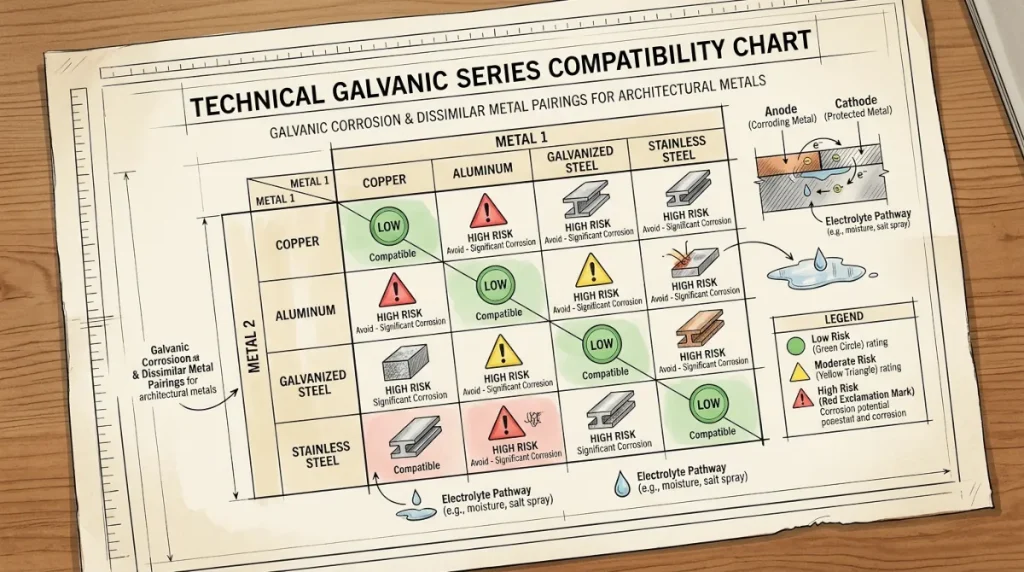
The following table documents the galvanic series positions and compatibility ratings for the metals most commonly encountered in residential and commercial guttering specifications:
Recognizing Galvanic Corrosion & Dissimilar Metal as a factor leads to improved strategies.
In summary, knowledge of Galvanic Corrosion & Dissimilar Metal fosters better decisions.
To conclude, addressing Galvanic Corrosion & Dissimilar Metal issues is vital for success.
| Metal / Alloy | Galvanic Series Position | Electrode Potential (V vs. SCE) | Role in Dissimilar Contact |
|---|---|---|---|
| Magnesium | Most anodic (active) | -1.60 V | Anode — corrodes first |
| Zinc (galvanizing) | Anodic | -1.05 V | Anode vs. all common guttering metals |
| Aluminum 3105-H25 | Moderately anodic | -0.75 V | Anode vs. copper and stainless — cathode vs. zinc |
| Galvanized Steel (G90) | Moderately anodic | -0.70 V | Anode vs. copper — cathode vs. bare zinc |
| Stainless Steel Type 304 | Moderately noble | -0.08 V | Cathode vs. aluminum, steel, and zinc |
| Stainless Steel Type 316 | Noble | -0.05 V | Cathode vs. all common guttering metals |
| Copper C11000 | Noble | +0.05 V | Cathode vs. all common guttering metals |
Critical read on this data: Copper sits at the noble end of the series. Aluminum sits 0.80 volts below it. That 0.80-volt differential is a large electrochemical gap — large enough to produce aggressive, measurable anodic dissolution of aluminum within a single wet season when the two metals are in direct contact with rainwater bridging the joint.
High-Risk Contact Scenarios: Field Failure Patterns by Metal Pairing
Steel or Aluminum Fasteners on Copper Gutters
This is the most common galvanic error on historical copper restoration work. The installer uses standard aluminum hidden hangers or steel hex-head screws because they are available on the truck. Copper is the cathode. Aluminum and steel are the anode.
The fastener — which has a small cross-sectional area compared to the large copper trough surface it contacts — experiences the small-anode-large-cathode acceleration effect. Anodic dissolution concentrates at the fastener shank. Within two to four seasons, the fastener cross-section is reduced enough to fail under static trough load. The trough drops at the hanger location. The pitch reverses. The failure cascade begins.
Copper Runoff Discharging into Aluminum Leaders
This scenario is less intuitive but equally destructive. Copper ions leach into rainwater as it flows across a copper gutter trough surface. That copper-ion-laden water then enters an aluminum downspout or leader at the outlet connection.
Inside the aluminum leader, the copper ions plate out of solution onto the aluminum interior surface. The plated copper deposits create localized galvanic cells — copper cathode, aluminum anode — distributed across the interior wall of the leader. The aluminum wall corrodes from the inside outward. The external surface looks intact while the interior wall thickness is being consumed. Perforation follows, typically within three to seven years depending on regional rainfall volume and copper ion concentration.
Galvanized Steel Hangers on Copper Troughs
Galvanized steel is anodic to copper by approximately 1.10 volts — a larger differential than aluminum-to-copper. The zinc coating on the G90 galvanized hanger sacrifices first, protecting the underlying steel temporarily. Once the zinc layer is consumed at the contact point, bare steel is exposed to the copper-electrolyte circuit and accelerated steel corrosion begins. Hanger failure on historic copper systems installed with galvanized hardware is a predictable, documented outcome — not an anomaly.
Field Isolation Protocols: Breaking the Galvanic Circuit
Galvanic corrosion requires electrical continuity between the dissimilar metals. Interrupting that continuity — physically isolating the two metals so that electrons cannot transfer between them — stops the reaction entirely regardless of the voltage differential between the materials.
Neoprene and EPDM Barrier Isolation
Neoprene washers and EPDM gasket material are the primary field isolation medium for dissimilar metal contact points in guttering applications. Both materials are electrically non-conductive, chemically resistant to the pH range of typical rainwater runoff, and dimensionally stable across the temperature range encountered in exterior architectural applications.
- Neoprene washer specification: Minimum 1/16-inch thickness at all fastener contact points where dissimilar metals are present — the washer must fully cover the contact face of the fastener head and extend beyond the metal-to-metal interface by a minimum of 1/8 inch on all sides
- EPDM sheet barrier specification: Minimum 1/8-inch thickness for hanger-to-trough contact surfaces on copper systems — cut to fully cover the hanger bearing surface with no metal-to-metal contact at any point within the barrier perimeter
- Barrier continuity: A single pinhole breach in the isolation barrier re-establishes the galvanic circuit at that point — installation must be inspected for barrier continuity before the hanger is loaded
Stainless Steel Fastener Specification
When physical isolation of the fastener is not practical — as in blind fastener applications or concealed hanger systems — the correct specification is stainless steel fasteners that minimize the galvanic voltage differential at the contact point.
- Type 304 stainless steel: Electrode potential of -0.08 V versus SCE — voltage differential of 0.13 V against copper C11000. Acceptable for inland residential applications in moderate rainfall environments where electrolyte conductivity is low
- Type 316 stainless steel: Electrode potential of -0.05 V versus SCE — voltage differential of 0.10 V against copper C11000. The correct specification for coastal installations, high-rainfall environments, and any application where electrolyte conductivity is elevated by salt air, industrial fallout, or acid rain conditions
- Pop rivet specification on copper: Stainless steel mandrel and body — never aluminum mandrel pop rivets on copper trough assemblies. The aluminum mandrel fractures and remains embedded in the rivet body in direct contact with the copper trough wall, creating a concealed galvanic cell at every rivet location
Dielectric Unions and Transition Fittings
Where copper downspout runs must transition to aluminum leaders or galvanized steel discharge pipe — a configuration that should be avoided wherever the layout permits, but which occurs on retrofit and repair work — a dielectric union fitting physically separates the two metal pipe ends while maintaining hydraulic continuity through a non-conductive sleeve.
- Sleeve material: PVC or CPVC — electrically non-conductive, chemically inert to both copper ion solutions and aluminum oxide environments
- Joint sealing: Apply silicone sealant to the sleeve-to-pipe interface on both sides of the transition — the sealant bead functions as both a hydraulic seal and an additional electrical isolation layer at the metal pipe ends
- Transition placement: Position the dielectric transition at the first accessible joint below the copper trough outlet — minimizing the length of the copper-ion-laden water path before it enters the dissimilar metal section of the leader system
For current ASTM standards governing stainless steel fastener alloy designations, neoprene and EPDM material specifications, and copper alloy C11000 product requirements applicable to architectural guttering applications, consult the official standards documentation maintained at ASTM International at astm.org.
While isolating your contact points with neoprene gaskets and heavy-gauge stainless fasteners effectively halts the electro-chemical destruction of galvanic action, these physical isolation barriers must still be engineered to survive the constant physical movement of your metal runs. To ensure your protective shims and joints do not bind or shear apart when temperatures shift, read our comprehensive analysis on Metallurgy & Thermal Expansion to properly align your structural material choices with calculated linear expansion tolerances.
Executing galvanic isolation correctly in the field depends as much on having the right physical components on the truck as it does on understanding the electrochemistry — stainless fasteners, EPDM barrier stock, dielectric fittings, and the correct pop rivet specification for the metal combination in hand are all non-negotiable parts of a properly equipped professional tool rig, and a full reference to the specialized guttering tools and materials required to execute these protocols at a production level is available at guttering.com.